
You either don’t know what Touhou is, or you’re scared of it.
This is going to be a slightly different article. Instead of talking about a single game, I want to discuss my experience with a franchise and its subculture.
The Touhou Project is a series of games beginning in 1997 with the release of the inaugural title, Highly Responsive to Prayers. That’s the real name. Don’t worry, it only gets worse.
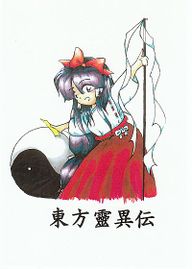
That game, and every official title in the Touhou Project, was developed by a single man, known by the moniker ZUN (I’m not shouting, it’s always capitalized). Highly Responsive to Prayers is a sort of Arkanoid, Brick Breaker type of game starring a shrine maiden character named Reimu Hakurei, who tends to the Hakurei shrine and must put down evil spirits who threaten the Gensokyo, a world based off of Japanese fairy tale and ZUN’s own imagination.
This first game spawned four sequels, gradually adding more characters and mechanics, but for the sixth game, ZUN decided to radically shake up the formula. You might notice that I’m skimming over what seems like a lot here, and that’s because I am. The Arkanoid-style is kept through these first five entries, and they’re mostly simple games which build on a foundation laid by the first. There is, however, an important detail here I haven’t mentioned. What set these first five games apart from just another Brick Breaker clone was the combat.

See, the ball (which is a Yin-Yang orb here) can touch the ground at no penalty. There are enemies who fire projectiles at the player, and you have to bounce the orb into them to defeat them while dodging their shots or cancelling them out with your own. Much like a scrolling shoot ‘em up, you have a limited number of screen clearing bombs to bail you out when things get too hectic.
What’s that? Did I say shoot ‘em up? Well, it’s quite possible that this was an attempt by ZUN to blend two genres of game that he enjoyed, and he especially liked ‘shmups, because his next game would belong to a niche genre that appealed to hardcore fans of diving, flying, and shooting. It was a…
Danmaku
Curtain Fire
…The Bullet Hell.
Bullet Hell is a subgenre of ‘shmups, known for their dazzling visuals, filling the screen with dozens and dozens of enemy projectiles at once in chaotic, heart-pounding gauntlets of skill.
Touhou 6: Embodiment of Scarlet Devil was the first title in the series to adopt the Bullet Hell genre, and it has stayed as such ever since.
(Minus a few side-entries)

Nowadays, Touhou Project is synonymous with the Bullet Hell subgenre as a whole, and these games have a reputation for being extremely hard. That reputation is not unearned, but what a lot of people (read: ~n o r m i e s~) get wrong is thinking that Touhou is just unforgivingly punishing and requires you to be some sort of superhuman to beat or even have fun with. That’s wrong; I’m a scrub and I love this series, I own like seven figures.
I want to tell you why you should play Touhou. To start, I’m going to be using primarily 6 and some of 10 as an example. These are the best for beginners, the former for its comparable simplicity and being where the series shifted into its real identity, and the latter for being a kind of reboot gameplay-wise using a new engine. It’s worth noting that 6 isn’t easy by any means, but that doesn’t make it bad for a newcomer.
You start up Embodiment of Scarlet Devil and are greeted with a loading screen with some wonderfully awkward Japanese-to-English translation.
“This game is Curtain Fire Shooting Game
Girls do their best and are now preparing. Please watch warmly until it is ready.
The border land was wrapped in Scarlet Magic. Girls believe that you solve this mystery.”
If you could understand that at all, then you just got about the most plot in this game. Not that Touhou has no story, it certainly does, but the dialogue is…
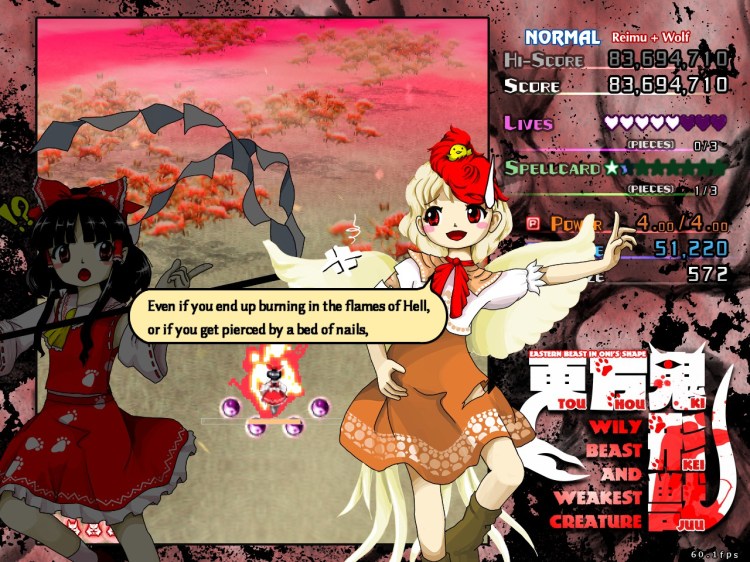
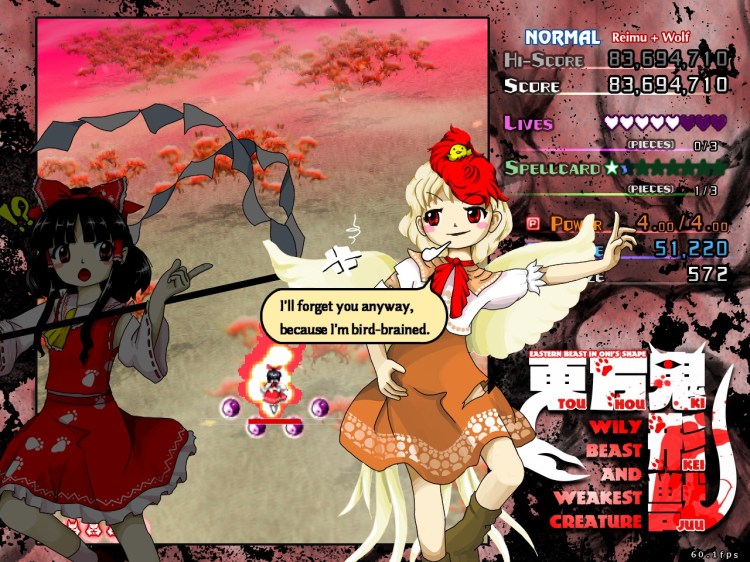


Embodiment of Scarlet Devil stars two playable characters, the shrine maiden Reimu Hakurei and the “Western Oriental Magician” Marisa Kirisame. They reside in the aforementioned Gensokyo, where a mysterious dark mist has covered the land. Not content to let the sun be blotted out, they set out to find the source of the fog; or, whichever one you choose sets out.
Generally, every game in this franchise has multiple characters with different attributes and abilities, and they cater to different styles and skill levels. If it’s your first time, pick Reimu.
You don’t do much in Touhou besides shoot. You shoot, a lot. Honestly, I don’t know why there’s a shoot button, because there’s never a reason to not be shooting. Reimu has these extra shots that home in on targets, while Marisa’s do more damage in a line.
Once you start blasting away these fairies throwing orbs at you, you’ll notice little red and blue squares. Red Powerups add to the Power meter, which tells you what tier your shots are at. Each tier piles on more and more extra shots that you will need for these games. Blue pickups are points, which don’t do anything, but are a form of cred. Among hardcore Touhou enthusiasts, points are the name of the game; I’m not that hardcore though, I play on Normal, at 60 frames. Oh, yeah, the game speed is based off frames, so uncapping that can make it almost unplayably fast.

The midboss of the first stage shows off what is, in my opinion, one of the series’ staple features, and that is these colorful attacks arranged in something like geometric patterns. It’s so distinct, and you can see its influence reach other games like 2017’s NieR: Automata, with its similar waves of enemy projectiles. Instead of the pure chaos of a lot of traditional ‘shmups, there’s a deliberate, concerted effort to make something visually striking; the shot patterns in Touhou games are almost like pieces of art themselves.
That same midboss reappears to cap off the stage after a little more swerving and shooting. Her name is Rumia: The Youkai of Dusk, and she’s where the real game starts. I’ve played this game a lot, so I can get through at least the first two stages without a death, but if you’re unprepared, Rumia can give you a rude awakening.

She fires off curved waves of orbs that you need to weave through. This is where the Focus feature comes in handy. Most Touhou games have a mechanic where, by holding the Shift key, you enter Focus, where the little orbs your bonus shots come from pull in tight and concentrate all of your firepower forward while slowing you down. This is where a higher damage character like Marisa really shines, as her Focus fire will melt bosses, whereas Reimu’s huge spread of homing shots makes quick work of regular stages.
Once you lower a boss’ health enough, they use their Spell Card, a special pattern that is guaranteed to be harder than whatever they were just doing. Bosses go through clear phases with multiple health bars, with a Spell Card serving as a kind of desperation-attack phase. While it’s active, they take dramatically less damage despite being at low health, forcing you to weave through the gauntlet of their attack. Because Spell Cards require a lot of concentration, rather than the normal phase where you can often blast through their health, finishing off a health bar and transitioning into the next, lighter phase of attacks creates a rhythmic series of highs and lows. Part of that rhythm is that every downed health bar drops a few powerups, and reaching max power will instantly turn any on-screen bullets into points. With some timing, you can snag valuable seconds for free damage.
Touhou likes you living on the edge. You might notice that sometimes, pickups will magnetize to you from full screen. That’s because there’s an invisible line about a quarter down from the top of the screen, and flying above that will automatically collect any powerups. In the earlier era, this only works once you’re at full power, but ZUN decided to make it possible anytime starting with 10. Speaking of living on the edge, Rumia fires a few static beams that are good for collecting Graze points. Yep, being close to a projectile without hitting it, or “grazing” it, will rack up a large amount of points. This might be confusing on first examination, because hitboxes in these games are… misleading, to say the least. See, Embodiment of Scarlet Devil is missing this feature, but in later games, going into Focus mode shows a little red dot at the center of your character– that’s your actual hitbox. That’s why it may seem like you’re making impossible dodges where a shot crosses through your head, and that’s because the spot you really have to worry about is closer to the waist.
Another reason Reimu is good for beginners is her speed. Marisa is pretty speedy, which may seem better, but the slower movement of the shrine maiden makes navigating complex Spell Cards easier.

That’s the key to understanding Touhou. You see all of these crazy visuals and colors and your first inclination is to get freaked out by the stimulus, but as soon as you take a breath and slow down, you realize that ZUN is on your side when designing these games.
Every pattern is designed to be dodged. Often, just standing still and inching back and forth is enough to dodge massive waves of bullets. If you take in your surroundings, you’ll find these “safe areas,” to maneuver to. Of course it’s challenging, the more intricate and messy a pattern is, the more concentration it takes to overcome it. There’s a concept in fighting games where, once you’re comfortable enough with your character, you stop looking at yourself when you play and instead observe what your enemy is doing. The same is true here; when I’m really “in the zone,” my eyes aren’t on my character, it’s the space around them, seeing multiple concentrated spots at once, anticipating shot paths.
Bosses have clear phases between regular attacks and spell cards, and you can initiate the next phase to start by lowering their health or literally waiting out the timer at the top of the screen. Sometimes, it isn’t viable to line yourself up with them to do damage, and it’s a better strategy to hold tight and dodge for another few seconds. If all else fails, you still have your bombs.
Ah, the bombs. By hitting X, you activate your own spell card, clearing enemies and projectiles in its path. Most games in the series allow you to choose from two alternate shot and bomb combos, which can further influence your playstyle. For instance, Reimu’s first scheme is her homing shots and a bomb that hits a smaller portion of the screen, but likewise auto-targets an enemy. Her second makes her play more like Marisa, trading in her extra homing shots for bonus firepower and a screen-clearing bomb. Marisa’s first scheme does a lot of focused damage, but both her shots and bombs have little coverage, whilst her second changes her bomb to a massive magic beam that shakes the screen, and swaps focus fire for two penetrating lasers that rip through lines of weaker enemies, but deal less damage per second. Touhou games are pretty conducive to replay, practicing, and experimenting with what you like.
In short, if you get overwhelmed, just bomb, there’s no shame.

Now, once you calm down, you might have noticed the music. Music is inseparable from Touhou, it’s a core aspect of its identity. ZUN’s knowledge of music theory is self-taught, and his compositions are instantly recognizable for their peculiar chord progressions and complex rhythms, as well as how many pianos, flutes, and trumpets he can stuff into a single track.
It can’t be understated how influential the music in these games has been in regards to its massive, hardcore cult following. If you find yourself browsing YouTube listening to independent Japanese music (because who doesn’t?), chances are you’ve come across at least one arrangement of a Touhou track. There is an entire scene of doujin circles (groups of independent creators) who put out full albums of music arranged from ZUN’s compositions in their own styles. There’s an incredibly wide world of Touhou doujin music, ranging everything from pop to rock to heavy metal to jazz; listening to the originals back-to-back with what these doujin circles create is astounding, you can hear the skeleton of the original but in a completely new form, it’s so cool. Some of my personal favorites include GET IN THE RING, Hatsunetsu Mikos, and TUMENECO. To quote TVtropes,
“To put the sheer number of remix CDs in perspective, there is a torrent which weighs over one terabyte (specifically 1.8 TB or 1,817,738,246,162 bytes) of over 3000 Touhou remixes, and that only includes the ones that the (English-speaking) maintainers of the torrent have added.”
ZUN includes a Music Room in every game, where you can listen to every track you’ve encountered and actually read his commentary about each one. It’s never super in-depth, but you get a neat window into his thought process, and funny little tidbits like ZUN admitting he doesn’t know why there’s a Stage 2 at all.

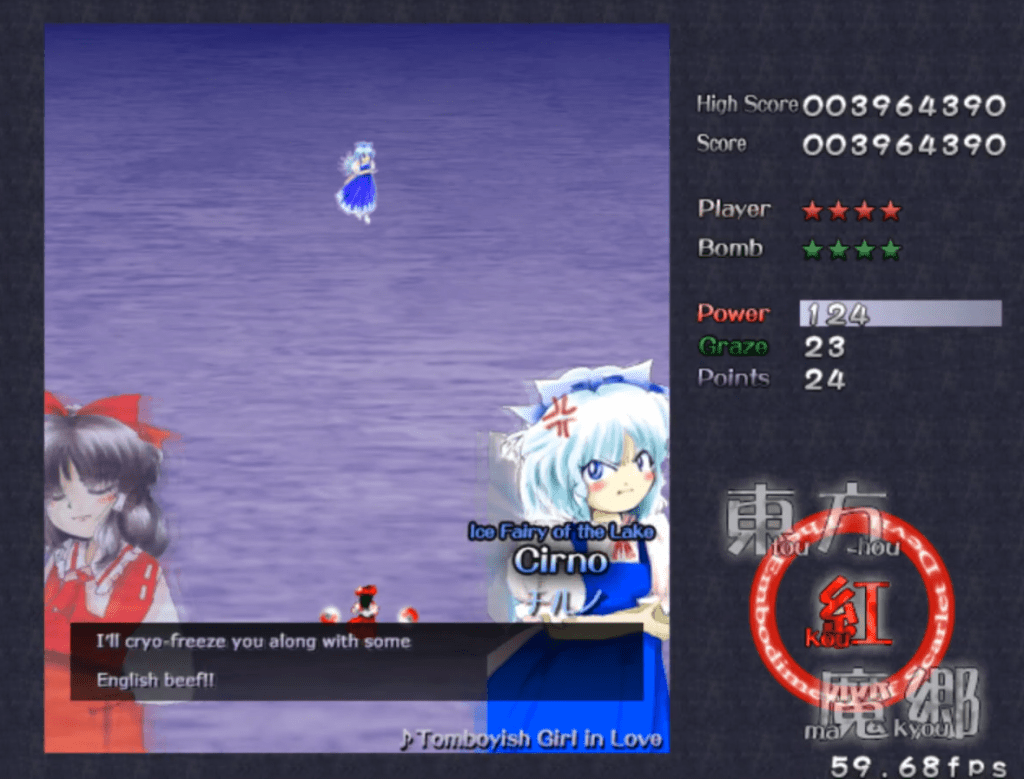
Speaking of, conquering Rumia should lead you to Stage 2. After interrogating the self-proclaimed Youkai of Dusk and finding that she has nothing to do with the black mist, Reimu is directed to the titular Scarlet Devil Mansion, separated from the land by a large lake made frosty by the presence of ice fairies. The boss of this level is none other than Cirno the ice fairy, and I’m forced to go into another tangent.
See, there’s a few things that I think go into giving a piece of media a sprawling, intense cult following. One is the volume of work to be invested in, the second is the general quality. There are two good Godfather movies, which is enough to make it extremely popular, but you won’t see anyone cosplaying it at a convention, you don’t see people setting Godfather clips to Linkin Park music to make a video. There’s a lot of Transformers movies, but they aren’t very good, and you can see the general lack of hardcore passion despite how much money it’s made. There’s a third, kind of ephemeral quality that needs to line up with the other two before you see terabyte-sized compilations of fan remixes.
For Touhou, it’s the characters.
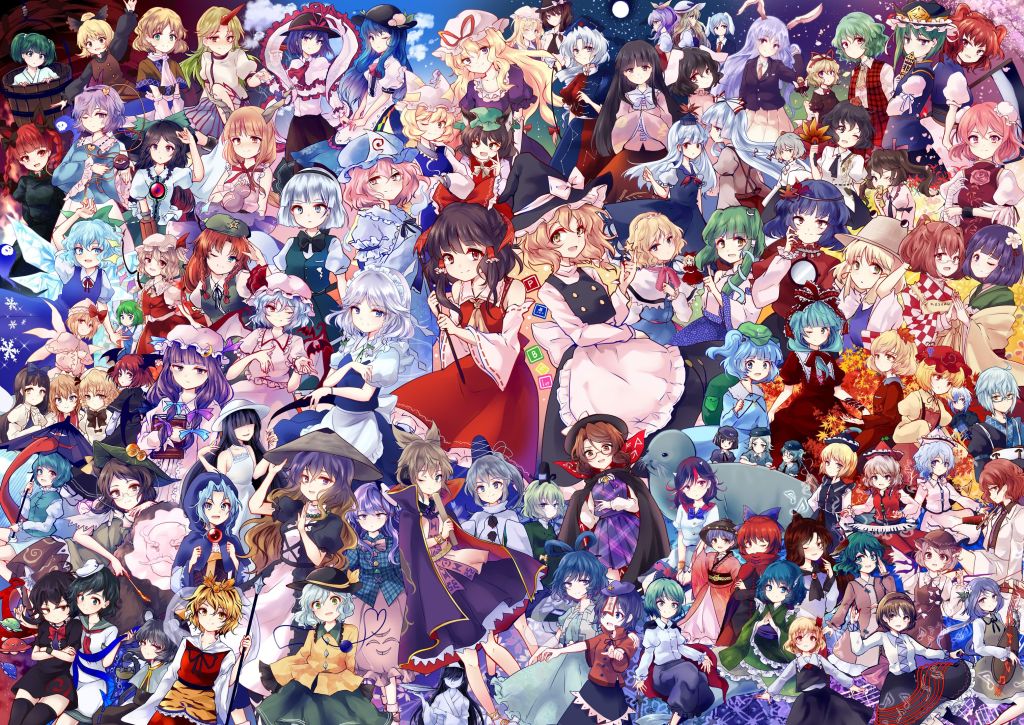
There are an unholy amount of characters in Touhou lore. Over 29 main series titles, ZUN has created over 180 characters, most of which provide one-off roles during stages.
This sounds crazy, and it is, but the reason it works is because, despite his, say, “limited” artistic abilities, ZUN is an incredible character designer. With some variation, every Touhou character is a small girl wearing a multilayered, frilly dress and something on their head, usually a hat, and yet they are all distinct. Everyone has some theme, some gimmick, some color scheme that fits into this formula.
His designs range everywhere from classic anime tropes to something completely out of left-field. A silver-haired maid with green bows in her braids? Sure. A fairy in an American flag-patterned dress and stockings who is also… a… clown?


You can say whatever you want, but you’ll always remember Clownpiece.
What I find so fascinating is that Touhou characters are easy to like while also being highly malleable. The dialogue offers you a general idea of their character, but all the shades of nuance are up to interpretation. Reimu can be a stoic shrine maiden just doing her job in one manga adaptation, or a badass Youkai slayer in another, and I buy either one. Tumblr user Huppaduppa, when asked about their thoughts on the fashion of Touhou characters, closed with this statement:
‘Maybe it’s just me, but I’ve always felt as if ZUN always lends reason an ear when he makes his stories and characters. It’s less “what kind of character should appear in this game?” but rather “what kind of characters would make sense to appear in this game?” He never seems to care about making popular characters come back, or making “cool characters” that people will like.
Maybe that’s why I always end up growing attached to pretty much every single one of his characters, because they exist so leisurely. I feel like the clothes maybe aren’t the best example of this in action, but with that overall feeling that Touhou Project has, it feels to me as if every character wears the clothes that she wants to wear, something that she herself [chose], for her own reasons. And I appreciate that, because I feel like that is something very, very basic about making a good character design.’
Let me give you one of my favorite examples of ZUN’s character designs, credit to u/Pichuunnn on reddit for pointing this out.
Okay, so there are two characters from Touhou 11: Subterranean Animism named Satori and Koishi, and they’re sisters. They’re both a species of Youkai also called Satori, who have a third eye that floats around them and allows them to read minds. This makes them quite powerful, but also feared and hated by other Youkai. Satori is content to guard the vengeful spirits who remain in hell after it is moved by the Buddhist death judges called Yamas, but Koishi is sick of a life of being feared. Departing from her sister, she forcibly closes her third eye, losing her powers of mind reading. However, in a monkey’s paw twist of fate, it also erases her conscious presence, and makes her unable to be either hated or loved. Once she is out of someone’s sight, she is forgotten. While Satori can sometimes see her, she can never truly love her sister because she can’t comprehend her. Now, with all that in mind, check this out:
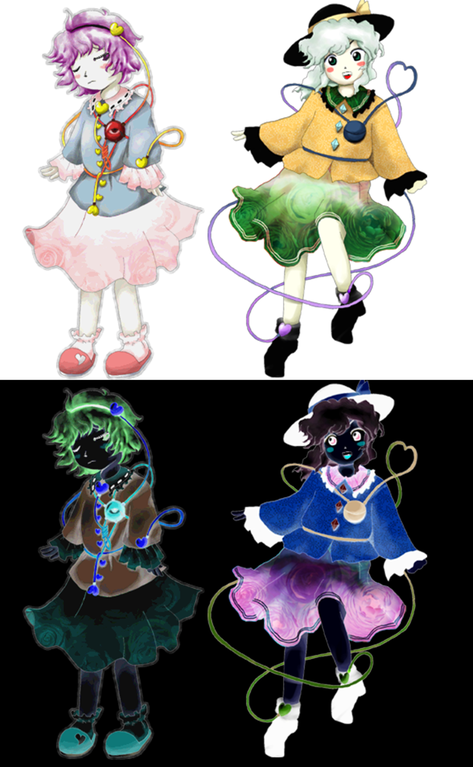
One of the big reasons EoSD is good for newcomers interested in the series as a whole is that the characters here are timeless, they’re some of the most popular in the community. Remember when I said I own seven Touhou figures? Yeah, two of those are Sakuya. I like Sakuya. You might not be getting to her, but you’ll be seeing her a lot in this game.

I’ve gone this long without talking about what I really love about the gameplay of Touhou. Now, I get it, not everyone likes extreme challenges, and that’s their right, but I find myself drawn to things that I know I’m going to have a hard time with. In my daily life, I’m usually pretty calm. I don’t like to invest myself very strongly into things in case something goes bad, and while that’s done a lot for my mental wellbeing, it also means that when something goes right, my reaction is also muted. With that in mind, games with high skill ceilings are the most rewarding to me. Breezing through the first three levels of a Touhou game only to come against a wall, slogging through repeated game overs and continues, and suddenly, I’ve forgotten to distance myself from the outcome; when I die, I curse excessively, and when I shave off the last bit of a boss’s health, it feels like I ran a marathon.
You aren’t just left out to dry entirely. The game is on your side, with multiple choices of difficulty and the aforementioned bombs. Games 6-9.5 allow you to increase your starting number of lives and bombs, but this is swapped for an infinite continue system in the games that follow. In the so-called “first generation,” losing all of your lives presents you with the option to use one of your continues, limited to three, at which point you respawn exactly where you were, and several powerups drop down which will immediately grant you full Power. The only downside to continuing is not being able to save replays, which may have been a factor in 2002, but there’s really no need today. This is yet another catch-up mechanic, but it won’t help much if you can’t actually clear stages.
ZUN decided to go with a different system for the second generation. As mentioned, you can continue as much as you like, but you need to restart from the beginning of the stage. This, I think, is actually a more forgiving system, as it fixes a design hole from the first generation. Every game has a practice mode where you can freely practice on any stage you’ve beaten; this might be useful if you’re going for points, but the majority of players just trying to progress won’t have much use practicing on a stage they’ve already cleared. In most cases, it’s the one stage they’re having trouble with at the furthest they’ve gotten, some enemy pattern or boss, that they really need practice on. The infinite continue system is a good compromise that allows you to practice the part that’s getting you without letting you savescum (or, continuescum?) your way through.
This is why I say that 10 is another good jumping on point. It also simplifies things waaaay down from previous games; not in a bad way, not dumbing down, just a “back to basics” approach. The formula for top-down shooters is quite easy to wrap your head around, which is why they’re kind of a beginner programmer’s game, and I think that for ZUN, the creative challenge was to add more on top of that formula. More playable characters, more crazy mechanics.
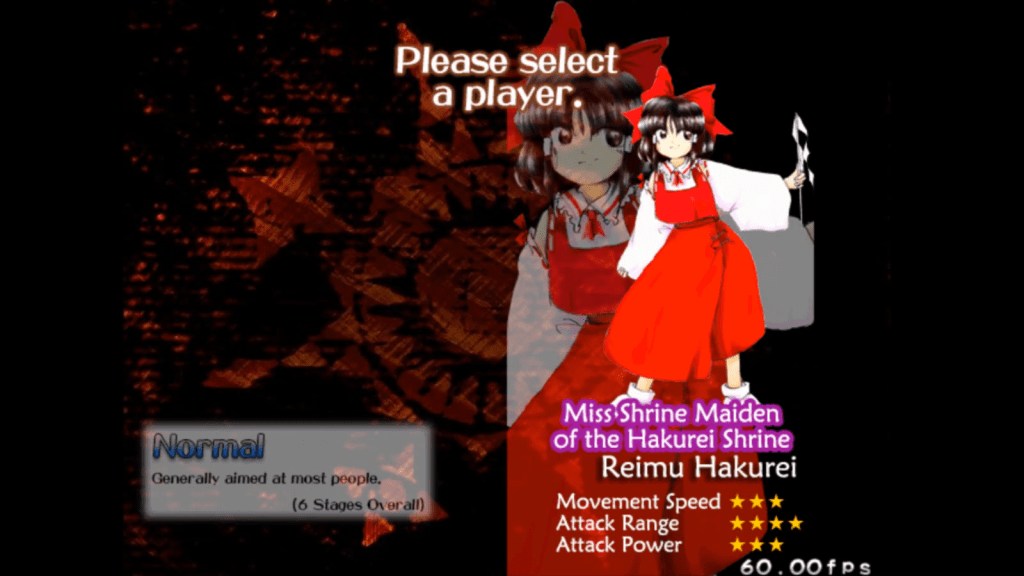

Okay, so Perfect Cherry Blossom, the sequel to Embodiment of Scarlet Devil, adds a third playable character, Sakuya Izayoi (hell yeah), who was the Stage 5 boss of the previous game. In addition, there’s a new mechanic called Cherry Points, which you rack up by killing enemies, and when your points are maxed out, you gain a temporary shield that will clear the entire screen of shots should it be hit.
Alright, that’s not too crazy. What about the next game?
Imperishable Night features eight playable characters, split into four teams of two. Each one represents your unFocused and Focused attacks, and your shots gain different properties depending on which mode you’re in, but follows that Focus mode concentrates your shots, except for Youmu and Yuyuko, who reverse that setup. Bosses have Extra Spells that you can challenge if you don’t die once during the fight, and losing to the Extra Spell won’t cost you a life. Also, there’s a limited time system where the game starts at 11 PM and progresses one hour every time you clear a stage and a half hour on continuing, reaching 5 AM at any point will trigger a Bad End; you can slow the passage of time by half an hour on clearing a stage if you collect enough time orbs, which drop from killed enemies and are worth more the higher your Graze score is; the acceleration of your Graze score increases depending on the Phantom Gauge, which shifts from one end to the other depending on which member of your duo you collect points and kill enemies more with.
Touhou 9: Phantasmagoria of Flower View invents its own genre, being a “Competitive Vertical Danmaku Shooting Game” AKA a head-to-head Bullet Hell including sixteen playable characters where you each play a separate Bullet Hell game, and killing an enemy on your side sends one extra shot to your opponent’s screen. Instead of having a set number of bombs, the Power gauge acts as an indicator for a Charge Attack Spell Card that can be charged up to five levels depending on how high the gauge is, and any levels higher than one will send a character-specific attack to your opponent while clearing your own screen, the goal being to knock them out by creating an unmanageable hail of fire to deal with.
Touhou 9.5: Shoot the Bullet (yes it’s called Shoot the Bullet) isn’t even a Bullet Hell, it’s a photography game where you take control of Aya Shameimaru, a magic newspaper reporter in the Gensokyo, and you pick from a series of stages which are just boss encounters where you need to snap a picture of them, getting extra points for including part of their unique shot patterns. Get it, it’s called Shoot the Bullet because it’s a pun, get it? Because you’re shooting a picture of the bullets?
Get it?
Touhou 10: Mountain of Faith features Reimu and Marisa as playable characters. You go in, you pick from one of three different shot and bomb schemes, you move, and you shoot.
That’s just about everything noteworthy. I won’t belabor the ending, because the plots of these games aren’t really why you’re playing it. Not that ZUN shouldn’t receive credit for his narrative ideas, but what you’re chasing is the feeling.
The first draft of this included a self-depreciating line about how I’ve never beaten a Touhou game before. While I was going back through Embodiment of Scarlet Devil for footage and screenshots, I actually got pretty far, to the last boss, in fact. Then, I died.
“Ah, I’ll take a break.”
I started up a video and got a drink when, all of a sudden, my internet goes out. It takes a while to come back after resetting the modem, so I figured, “Alright, why not give it another shot.”
Twenty-five minutes later, and I’m back at the last boss, I’m back at Remilia. I have two lives and one continue left. Every death sets my bombs back to three. “No way,” I thought. “Is this doable?” I taped down the fire button, swerved, dived, and made liberal use of my bombs. I was looking at four of five portions of the screen at once, watching the paths of bullets shoot past Reimu; the split-instant one got close enough to hear the death sound, I smacked the bomb. I couldn’t even think about anything else, it was just me, the game, and this sick music.
And then…
A burst of white pixels, the rip of a synthesizer, and then, stillness. The end-of-level scoreboard rises, and all that high-strung tension is released in a second. To say that it was high is an understatement, my body felt light. I imagine this is what doing a whippit feels like. I’m writing this mere hours after, and I’m still not over it. I leaned back and simmered in the feeling.
“I can’t believe I did that!”
Look, there are many nuances that go into even “simple” games like top-down shooters, and I could spend all day dissecting every game in the series, and how their subtle alterations to the formula affect it as a whole; I could talk about the hours of amazing music; I could talk about individual character designs and ZUN’s visual inspirations; I could talk about the community, which has somehow made the series the biggest obscure thing I can think of. That isn’t my intention, though.
What I really want to do is talk about the porn.
Okay, I’m not doing that.
This is not a series, or even a genre, for everyone. It’s big, it’s intimidating, and it’s hard.
Wait, am I talking about the porn?
But it’s great. I love Touhou, and I’m a scrub. Even if you don’t like the games, you might love a character, or a music circle, or an artist, or an adaptation. Maybe, you can just respect the fact that this sprawling franchise was created by one guy while he was a university student.
In an interview with Swedish magazine Player1, when asked how he started his own one-man developer, Team Shanghai Alice, ZUN responded:
“I started TSA [because] I couldn’t find any games I liked myself. Year after year the games keep getting split between big games and cheap games. I wanted a game that appealed to me, so I had to start making games myself…
Player1: What games do you want to create in the future?
“I’m going to keep making games that stand out. So if all my fans disappear, I’m still happy… I can keep doing the games I want.”
 Taigen Moon Works
I have a long, weird history with this series, just like a lot of other people who have gotten into it. It’s been a long time since I played any of the Touhou games; I think 10 was the last one I played much at all. I still listen to the music, though. There’s an incredible amount of fan work out there, not even including all that porn you mentioned.
LikeLike