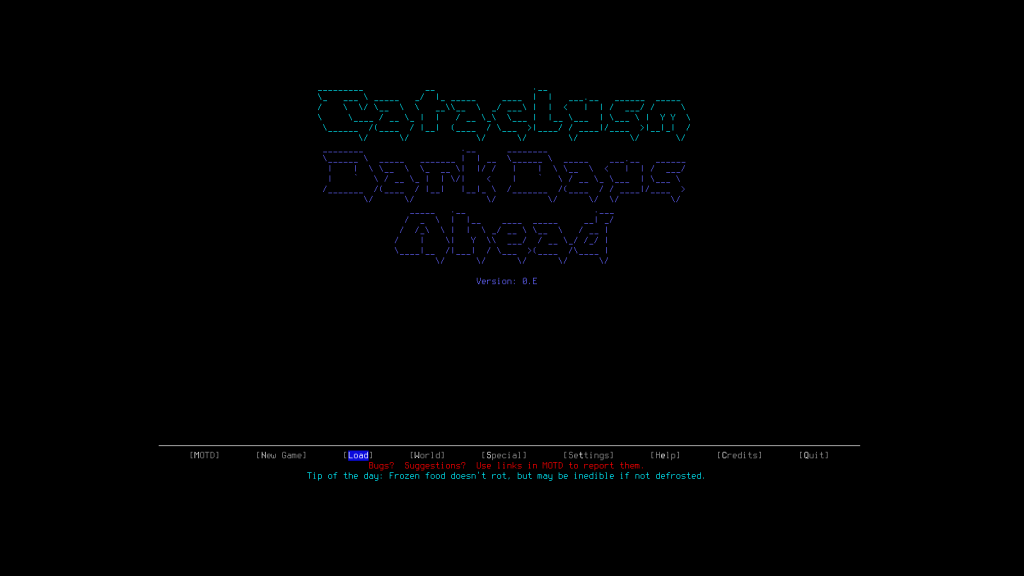
There’s an inherent appeal to primitive graphics. As with all other artforms, it’s often the way that creators subvert their limitations that the most impressive works are derived.
There’s an inherent appeal to survival games. For most of us in the first world, real survival is something we aren’t faced with. Sure, we might go into the wilderness however often, but at the end of the day we always return to our homes, our electricity, our familiarity. Survival is a lost experience in our day, so it’s natural that we seek it in our entertainment. Countless movies, books, series about individuals or small groups living off of the land and struggling against the onslaught of nature; now we come to video games– of course, this should be the most vivid, realistic portrayal of survival, right?
Unfortunately, all games have some inherent limitations; you need rules for the engine to work, and that leads to brick walls in the pursuit of realism. A lot of survival games aim for this photo-real depiction of the world, with vast, 3D environments, but this, ironically, is another limiter. The world can only be so big, so detailed, for hardware to keep up. There are bound to be things like graphical bugs, wonky physics, and jarringly abstract mechanics that clash with the realistic aesthetic. Often, you’re just meant to “fill in the blanks” when you craft an item or put up a shelter.
But what if there was a better way? What if you could smash through these brick walls by, ironically, limiting something else?
Cataclysm: Dark Days Ahead is an independently developed roguelike survival game, rendered entirely in beautifully crunchy ASCII graphics. That’s right, a survival game with permadeath.
This game is sick, and part of what’s so impressive about it is how many subtle things come together to make its uniqueness work.
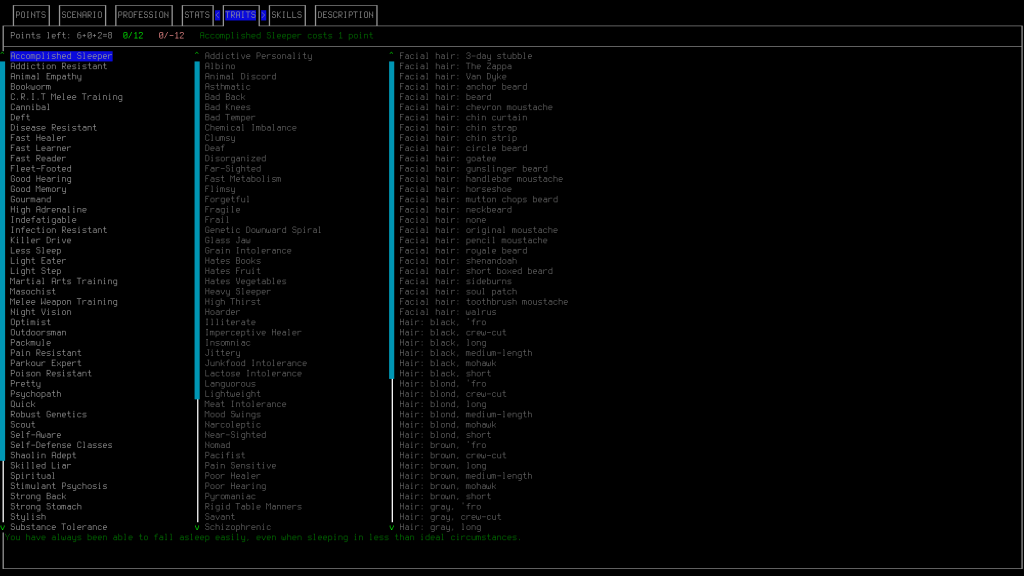
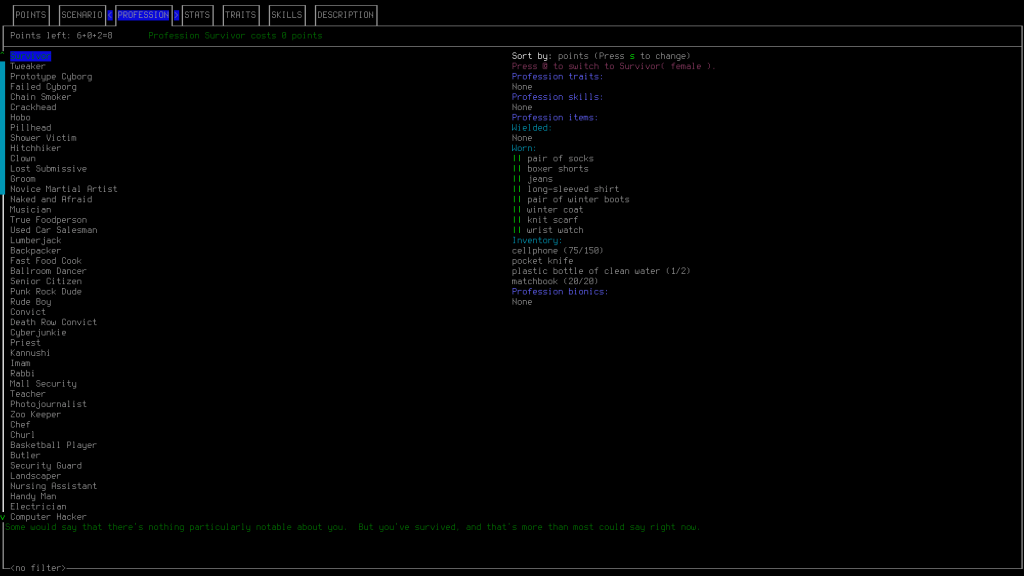
Every run begins with an in-depth character creation process. Even on my twelfth run, there are things I’m discovering about it.After generating a random world, choose a scenario; C:DDA takes place in a zombie post-apocalypse, and you can start in a wide variety of setups. Are you an evacuee in a crisis shelter, or were you locked in prison when the outbreak occurred? Maybe you stayed in a shelter for several months, and now that supplies are running low, you need to venture out. When society fell apart, were you working your shift as a fast food mascot or a miner? Every scenario gives you more or less skill points to spend based on difficulty, and there are a host of “challenge” scenarios that range from being an ill patient in the sick ward to starting off in an alien prison camp.
Oh yeah, aliens. Because C:DDA isn’t limited to just zombies. In fact, not only can you stumble across landed alien ships (whose guards will fry you), there are technical facilities swarming with killer robots, killer plants, and cave-dwelling mutated horrors. This is the massive benefit of a limited ASCII art style, there’s no need to model and animate everything with high resolution textures and lighting effects; the developers can basically just program something, make a single custom sprite, and check for bugs.
ASCII graphics are fascinating for their ability to take symbols and recontextualize them into something else, much like how this game is itself a fork of another title, simply titled Cataclysm, which ended development in 2012. Cataclysm’s creator, Whales, released the source code, and the community has run with it ever since to produce this game, which is still being updated.
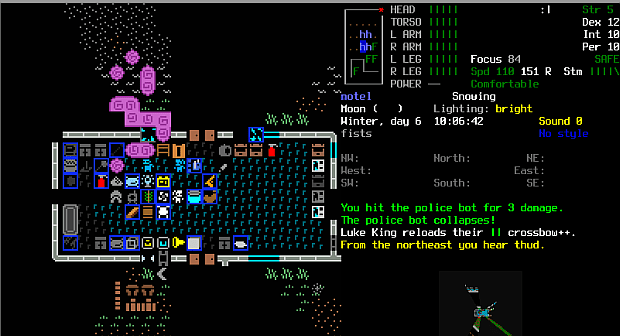
If you’re like me, though, the second you hear ASCII graphics, your mind jumps to Dwarf Fortress. I’ll be honest, I’ve tried getting into Dwarf Fortress, I really have, but its presentation is just a mess. I find myself staring at the screen until my head hurts just trying to understand what I’m looking at.
C:DDA avoids this in two ways. First, it uses a wide variety of custom tiles, all of which fit the artstyle while keeping everything readable; every object looks like it should. The second choice is to use a dramatically simplified interface. Where Dwarf Fortress throws so many options at you that it melts your brain, this game opts to only show you relevant information. The conditions of each part of your body, your mood, your focus, several different aspects of the weather, how thirsty, hungry, and tired you are, how much pain you’re in. While the actual function keys aren’t shown, there is an exhaustive in-game hotkey list, with virtually everything remappable.
After selecting your character’s skills, profession, weaknesses, and general stats, you are thrust into the world you’ve randomly generated. Your one objective: survive.
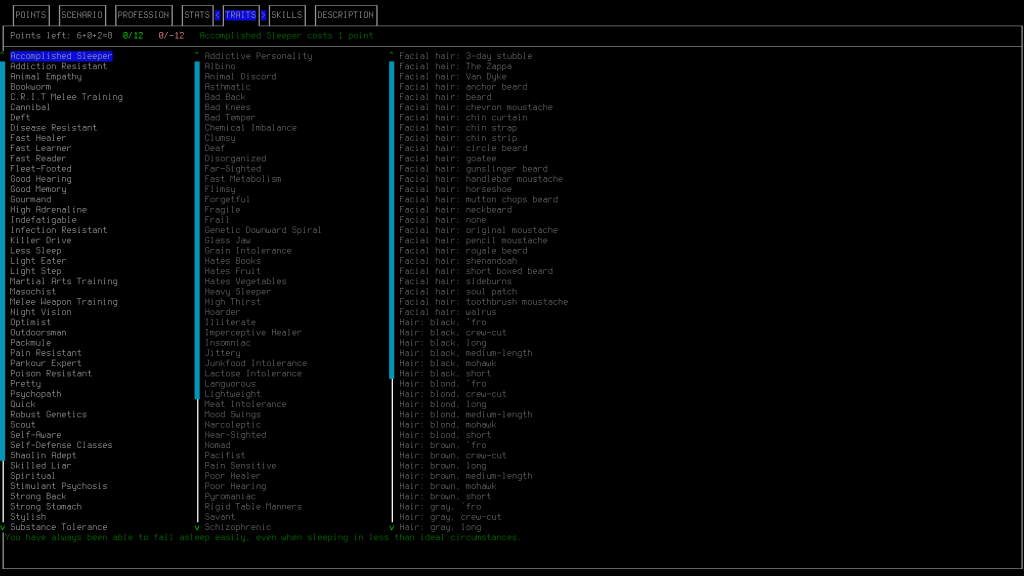
The basic controls might be seen as obtuse or overly complicated, but I think it’s more accurate to say that it just goes about things its own way. A lot of games have a universal function key, used for everything from opening doors to picking up objects and talking to people. C:DDA decides to map opening doors to ‘o’, and talking to NPCs ‘t’; picking up items is ‘g,’ and so on. There are a lot of options and mechanics, but once you get comfortable doing the basic stuff, it comes pretty naturally.
If it’s your very first run, I’d suggest going with the evacuee scenario. It’s the first option and kind of the “normal mode” scenario. It does a lot to teach you about the game, as well. You begin in a run down shelter with one other person. Feel free to talk to them and accept a task. You can do it, or not. There’s no penalty for it one way or the other.
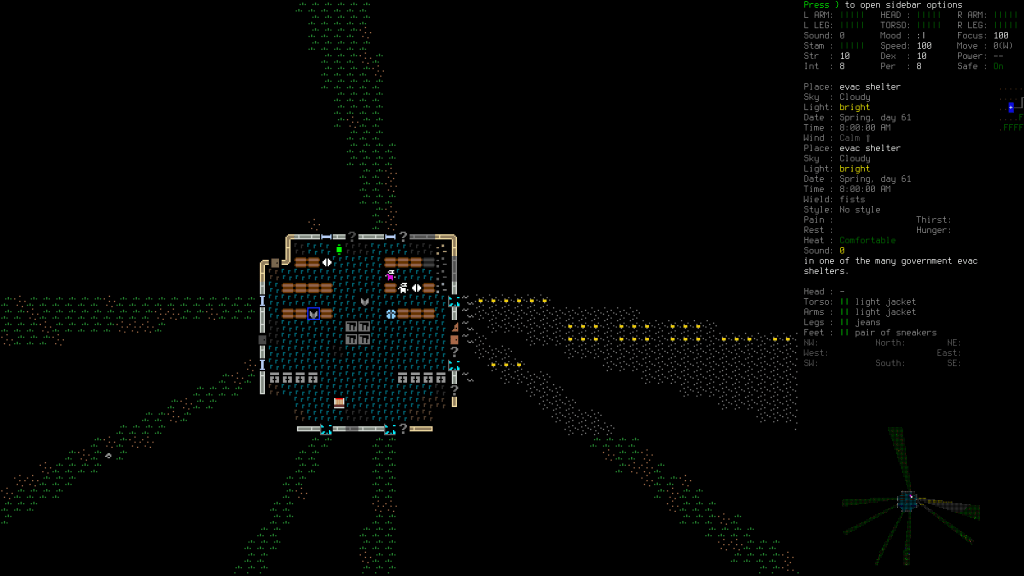
You’ll also notice that a lot of the world is blacked out. C:DDA has a fog of war that obscures angles of the environment your character wouldn’t be able to see, such as through walls and such. To compensate, there’s a “safe mode,” where you will automatically stop and be alerted when a hostile entity appears. This gets impractical when you catch sight of a large horde of zombies, so you’ll be tempted to disable it with a quick button press, but by doing so you also lose that bit of information that may be valuable.
From there, you can grab whatever you want from the shelter (there’s always more stuff in the basement) and head out into the ruined world, or don’t. There’s no penalty, but you will need supplies and shelter. This is your first priority. Maybe you can activate a computer terminal in the shelter and search through text logs to find the coordinates of a nearby shelter. Venturing there, you might find a desolate building with only a few useless items, a goldmine of valuable tools, or a field of zombies. There’s no telling exactly what will happen, as everything is generated randomly as part of its roguelike design.
There’s another crucial part of that roguelike formula I haven’t touched on much, though: permadeath.
Just like in Binding of Isaac or Spelunky, once you die, there’s no coming back. While you can save mid game, there is no option to reload a save except to continue your run from the main menu. You’ll likely die pretty quickly in your first few runs, so just take those as tests to get a feel for the game, and especially to learn about character creation. As the creator is so in-depth and you’re presented with so many combinations, spend some time tinkering around in it. For some, this is the most exciting part of the game, but others may find it boring, in which case you can start with a randomly generated character. Be warned, though, this is best done when you’re comfortable with the mechanics and aren’t afraid to give yourself a challenge.
Because you spend so much thought on building your character, losing them has a lot more punch than other roguelikes, where you don’t just lose your progress, you lose a person. Don’t be fooled though, this game does not need you to be invested in your character. When you die, you get to leave your last words on a gravestone, followed by a quick summary of your run, and the message “Your name is lost among the billions.” Cataclysm: Dark Days Ahead is, thematically, about the insignificance of a single life. In a weird way, this is its most discouraging and encouraging message.
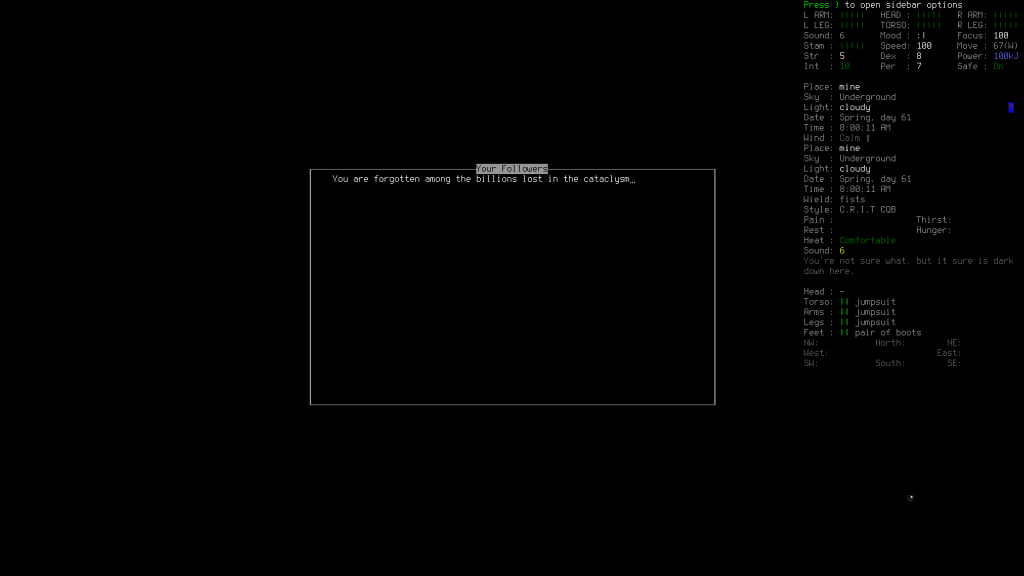
Sure, your life didn’t really matter in the grand scheme of things, but that means it’s no big deal to go. You just start another run with the knowledge you’ve accumulated. At the risk of becoming a self-parody, it’s a lot like Dark Souls, a series known for its crushing difficulty and bleak tone, but ultimately one about never giving up.
If you wouldn’t like to die, though, you might want to learn the combat mechanics. They’re surprisingly simple, sort of. Attack things with your equipped weapon by running into them, much like the original Rogue. Shooting is a little more complex, having to set up your aim, wait to focus a shot, and reload, but the game includes a guide to all these, as well as showing the relevant hotkeys when you’ve got your firearm out. In a game like this, stopping to read a guide for a few seconds isn’t much of a flow-breaker as in others, because it’s all about being methodical and understanding lots of different processes. The first time I figured out how to fill a canteen I’d picked up with water from a pond, then make a fire to purify it, I felt like a champ.
Got a little off track from the combat.
There’s multiple different fighting styles, mostly decided from character creation. Your character might be a practitioner of Krav Maga or Judo, you can set which one you default to, and it does change how you fight and which fights are advantageous for you.
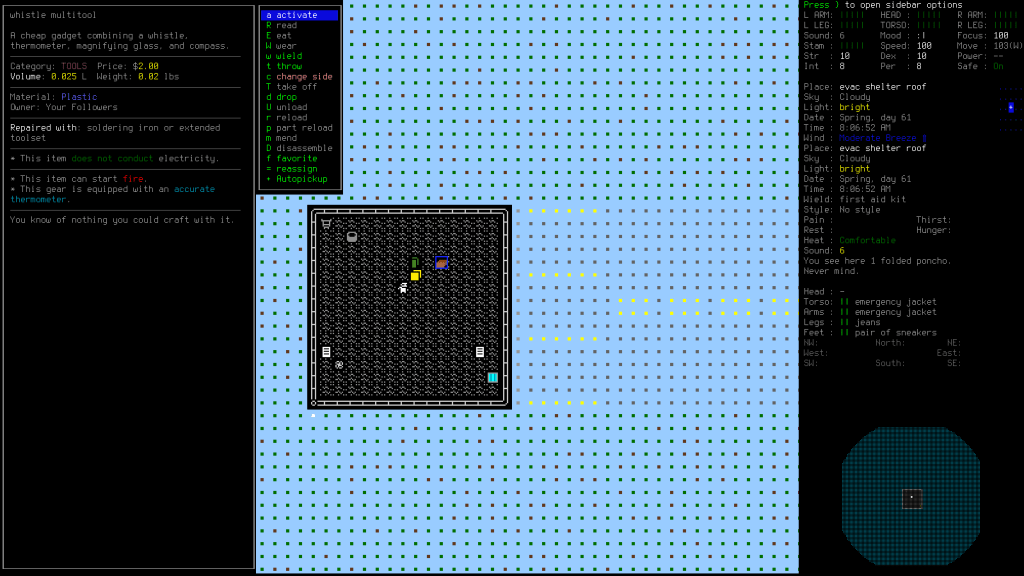
This game has the best equipment mechanics I’ve ever seen, just for the sheer flexibility. Each limb, hand, foot, and body section are counted separately, and multiple layers can be worn on each. You can be fully decked out to survive the cold while equipped with a backpack to increase your storage capacity, a strap for a rifle, multiple jacket pockets for small items, and a toolbelt for even more. You found an item you want but you’re at your carry capacity? Just pick it up in your hand and carry it back. It may sound small, but lots of games don’t give you anywhere near the amount of freedom this one does with items. Learning to play it was a constant series of “You can do that?” whenever I learned of some function the developers had included for almost every item. You went into a house to find supplies and found a zombie; you didn’t have enough time to remove your backpack and were forced to fight encumbered. You won, but some of your clothes were torn and your leg is bleeding. Use some paper wrappers as kindling for a fire, heat your knife, and cauterize the wound. You’ll be in extreme pain and unable to move, so you better have found a safe spot. From there, just select to wait for a few hours, making sure to hydrate when you get thirsty, and move out if you can. If you didn’t have a knife, you can open a medical kit and treat the wound, but you’ll need to make sure you wash it so it doesn’t get infected.
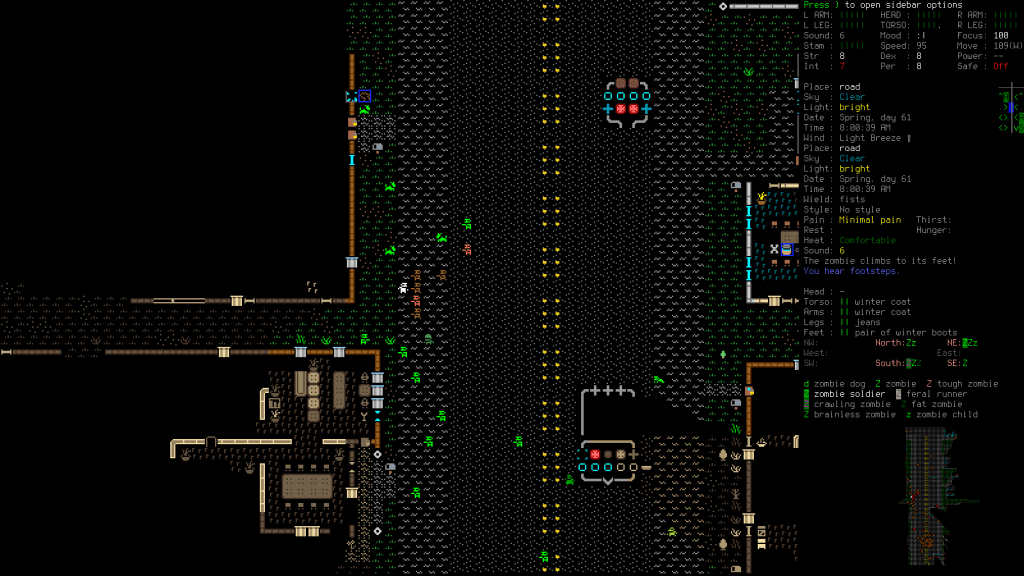
This is just one example of how open and freeform this Cataclysm: Dark Days Ahead is, and this is just the base game. Again, this game is easy-peasy to develop for because of how simple the presentation is, and there is an active and dedicated modding community always working on fun additions like dinosaurs, magic, new weapons, items, scenarios, and much more. This is a game that you can go back to time and time again, that invites you to learn more about it’s incredibly deep systems. There’s very little “video game logic” in C:DDA; if you can imagine how you’d solve a problem in real life, chances are that you can do just that.
There are many more things I could talk about, from personal anecdotes to mechanics I didn’t cover (you can become a cyborg??), but I think that part of the magic is discovering things for yourself. As the official wiki warns when on certain pages:
| WARNING: This page may contain spoilers and ruin the joy of adventure.Remember, it is not ‘dying’ it is ‘learning how to do better next time’! |
Oh, did I mention that the game is incredibly lightweight, and also entirely free? Why haven’t you downloaded this game yet?
Official Website: https://cataclysmdda.org/
Wiki: https://cddawiki.chezzo.com/cdda_wiki/index.php?title=Main_Page
 Taigen Moon Works