
When I was a kid, my friend loaned me his copy of Pokemon Diamond for the DS, and for years after that, I said, “I just don’t like JRPGs, they aren’t for me.” Then one morning, in my freshman year of highschool, I randomly woke up at 4 AM and decided to play Final Fantasy VI.
I no longer say that JRPGs aren’t for me.
A few years ago, I wanted to try First Person Shooters, because I like games with challenging skill-ceilings, so I downloaded Counter Strike (which I perceived at the time to be the “purest shooter”). I played it for 2 hours, and have not touched it since. I said, “I just don’t like shooters, they aren’t for me.” Then I watched YouTuber WoolieVS’s playthrough of Doom Eternal and found myself curious again, but in something older, what that game was throwing back to. I picked up Ultimate Doom, Doom II, The Master Levels, and Final Doom in a bundle for $5 off Steam, then downloaded a sourceport to play with some quality of life fixes.
I no longer say that shooters aren’t for me.
I still don’t like Counter Strike, though.
What was this gameplay? This design? It was so radically different from every FPS I’d seen before. It wasn’t lumbering through a brown, dusty military setting where you got into a combat encounter, shot some, ducked behind cover while your health regenerated, shot some more, reloaded, and then moved on. Doom was about movement; fast, fluid movement, where your aim mattered less than how quickly you could strafe out of harm’s way from the demons, each of which forced you to react differently, blasting them back to hell with the best goddamn shotguns in any game, ever. You didn’t even reload.
This was the first-person-shooter for many years, until 2003, when Call of Duty changed that. Its more realistic setting, going for a period accurate representation of World War II, where any stray bullet could kill you, was intentionally brutal and unforgiving, just like the war. It introduced things like regenerating health to make up for the swiftness of death, and lengthy reload times as a new, grittier take on the genre.
I think that despite those mechanics and balance decisions existing for a very specific, thematic reason, a lot of developers just mindlessly copied that formula, and for a long time we lost what made classic shooters so exhilarating, why they lit the world on fire. But I don’t want to talk about that. I want to talk about the perfection of the genre.
I want to talk about Blood.
Blood was released in 1997 and was made using the Build Engine, the same one introduced by Duke Nukem 3D one year prior. The games industry has always been fiercely competitive, and developers and publishers aren’t afraid to rip on each other with edgy marketing campaigns and hidden references. Duke 3D was no exception, it was coming off the heels of a year without a release from id Software, the pioneers of the FPS genre, and it positioned itself as bigger, better, and badder than Doom in every way, with enough mileage to even compete with the upcoming Quake.
The ticket to this confidence was in the Build Engine, originally designed by Ken Silverman. Where Doom’s engine, now called idTech 1, was a solid, stable piece of software that could render diagonal walls, stairs, lighting effects, and verticality while technically being a 2-dimensional game, the Build Engine was capable of all that and more. Destructible environments, a wider host of interactive objects, rooms above rooms. When John Carmack saw it during Quake’s development, he said it was “held together with bubble gum.” It was indeed a hacked-together, buggy, janky mess of an engine, but it worked well enough to hold up the illusion of being the Doom-killer.
The Build Engine was licensed out to several other studios, and Blood was among the last titles released using it. It was developed around the same time as Shadow Warrior, which came out only months later, but Blood is near universally hailed as the best game created using the technology.
Blood, developed by Monolith Productions and published by GT Interactive, puts the player in the shoes of Caleb, an old west gunslinger and follower of the dark lord Tchernobog’s Cabal. He is so devout, in fact, that he and three others, including his girlfriend Ophelia, ascend to the rank of “chosen.” For some unspecified reason, each of the chosen have failed their master, and he has terrifying monsters whisk them away before sending Caleb tumbling into a void.
“Consider my power… in a hollow grave.”
But Caleb is a little tougher than death, it seems. After spending a few years underground, literally, the first level opens with him rising out of his grave and uttering the words,
“I live… again…”

I want you to understand how awesome Blood is; here’s the first four levels, in summary.
You awaken in a mausoleum, find a bundle of dynamite in a secret wall, leave the tomb and fight axe-wielding zombies with your pitchfork. Grab a flare gun off the ground, and you can shoot flaming projectiles into enemies, lighting them ablaze and causing them to run around screaming.
Bust into a funeral home, and there are some shotgun wielding cultists above you. They can be dispatched with a shot from the flare gun’s secondary fire, which shoots eight flares in a diamond pattern which explode. This, naturally, blows the cultists away, smashing the decorative vases to pieces next to them to pieces as you set fire to some more in the main hall.
The funeral home leads back outside to a train station. After fighting your way through that, you’ll probably get the tommy gun, Blood’s rapid-fire weapon with an alt-fire that lets you wave it around wildly Scarface style, causing cultists to jump to the ground. The train station connects to– what else? A train level.

The train is brutal, in a good way. You run through the cars, shooting down enemies and snagging the guns akimbo pickup, which lets you dual wield any gun (for a limited time) and is as badass as it sounds, until you throw open a set of doors to reveal a whole dining car full of them. Throwing bundles of dynamite and launching wild flares is your best way of making it through this kind of firefight, playing smart and patient. The cars have two floors, as well, and you can find a key to take an elevator up, or spot a crack and throw some explosives to bust a huge chunk out of the car’s side, giving you another way up. The level ends with you overloading the train’s engine and crashing headlong into… a haunted carnival? Yep, and guess what? It’s also swarming with zombies, cultists, and new flying gargoyle enemies.
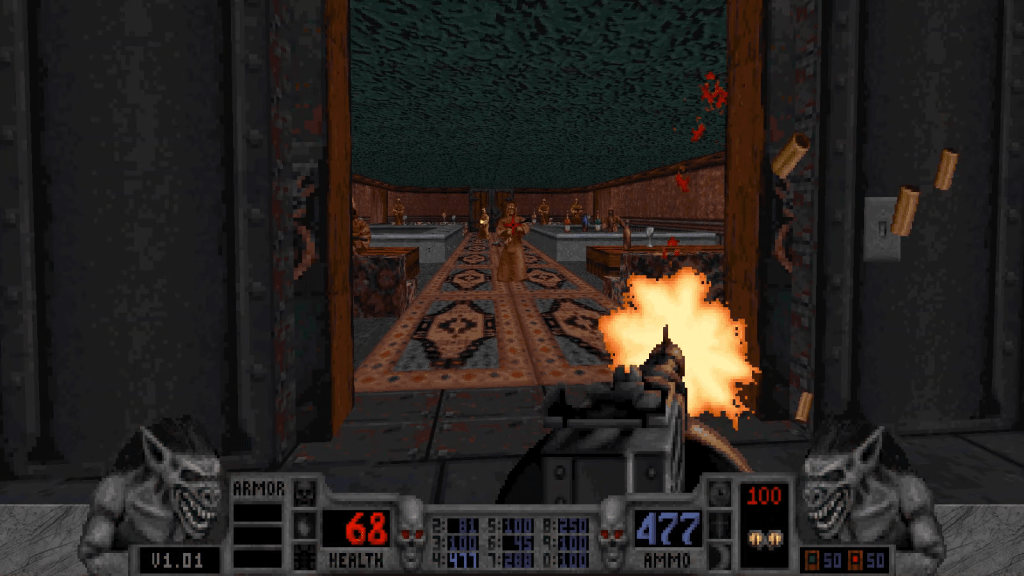
The flow of Blood’s levels is unmatched, one into the next. The atmosphere is dense; the sky is always dark, everything is a twisted, corrupted version of a location you might know, with a strong southern gothic bend to the early portions. It loosely takes place in the late 1920’s, although there are many aspects of later decades, as well as numerous pop-culture references made by Caleb himself.
Oh, right. This is a Build Engine game, and I’m pretty sure there was a stipulation in the licensing agreement that any game made with it needed to have a voiced protagonist. Duke Nukem was a steroid-pumping, cool guy Schwarzenegger-type who was an homage to cheesy action movies. Lo Wang, protagonist of Shadow Warrior, was likewise a throwback to cheesy kung-fu movies. Duke has an entertaining, but very thin personality, and Lo Wang is basically a lot of stereotype jokes that haven’t aged… amazingly…
Caleb, on the other hand, is taken a little more seriously. His character is clearly inspired by Evil Dead, which he makes reference to often, but he’s much more than that, and is helped by having a beyond stellar vocal performance by Stephan Weyte. His gravelly, Clint Eastwood delivery is easygoing, seemingly unconcerned by the bloodshed, with hints of extreme sadism. Every now and again, though, that sadism will break through the surface, and when tossing dynamite, he may let out a maniacal, full throated cackle as it explodes. He has a penchant for showtunes, as well, and sometimes begins humming a bit of “I Enjoy Being a Girl” or “My Favorite Things.” These funny anachronisms only add to his menace, and are the little things that make a pretty static character memorable. He doesn’t develop or change at all over the course of the game, but why would you want him to when he’s so rad?

A lot of that radness also stems from the creative selection of weapons. There are a lot, lining the entire number row for quick hotkeys. Duke and Shadow Warrior also have about the same number of weapons, but what sets Blood a cut above is that each one has two firing modes. I touched on it a little before, but something the Build Engine allowed for was weapons having multiple functionalities. I’ve spoken about the flare gun and tommy gun, but I’ve neglected the sawed-off shotgun.

Shotguns are important in these old shooters, because movement is fast and taking time to aim could get you killed. Blood’s shotgun is up there with the best, and although it lacks the sheer hammer-to-your-head impact of Doom II’s super shotgun, it is a lovely little thing. Instead of separate single barrel and double barrel weapons, which some other games opted for, the sawed-off lets you fire one or both barrels with the primary and secondary fire, adding a layer of skill to ammo consumption. It’s the only weapon that has to reload when both shells are expended, and that could mean life or death.
The other star of the show is the dynamite. The primary fire throws a bundle that explodes on contact with anything, but the secondary lights the fuse, setting it on a timer. This allows you to strategically bounce it off walls and around corners, and a huge part of the combat is utilizing the level layouts with your dynamite to take out enemies safely. You are flush with the stuff, too, as there always seems to be a pickup around.

The sound design is excellent. Without mentioning the distinctive noises made by enemies that hint at what’s around the corner, every weapon has these punchy, crackling sound effects that make them feel great to use. Tossing dynamite into a room, then seeing the bright explosion launch three or four screaming cultists while shards of glass and wood fly all over the place…
Why haven’t you bought this game yet?
Other members of the arsenal include the napalm launcher, the game’s rocket-launcher substitute that hurls fiery death; an aerosol can Caleb matches with his lighter to turn into a flamethrower and whose alt-fire makes it a fire grenade; a Tesla cannon that shoots waves of electricity and rips through enemies; a staff that drains enemy health, and yours if you run out of ammo, and a voodoo doll that Caleb stabs to force enemies into a stunned pain state.
Some of the alt-fires aren’t worth going over too much, but suffice to say that this is one of the most fun sets of weapons I’ve seen in an FPS, even from this era.
Good weapons don’t mean much if there aren’t good enemies to challenge you, and oh boy, does Blood have a rogue’s gallery. It’s one of the hardest games you’ll play, and part of that comes down to the understanding of how enemies should be designed.
Doom laid the groundwork for what I’ll call the “chess piece” theory of enemy design in first-person shooters. That is, every enemy serves a different function and forces the player to respond in specific ways. By crafting different combinations of enemies in different level layouts, you can make hundreds, if not infinite, fresh experiences for the player to encounter. In Blood’s case, it’s certain little nuances and behind-the-scenes mechanics that make its enemies some of the most challenging in the genre.
For a quick explanation, weapons in first-person shooters generally function in one of two ways. The first is a projectile; this would be a visible, physical attack that moves across the screen, like a fireball. The second is called hitscan. Hitscan means that when you fire your weapon, there is no actual bullet that comes out; the game draws an invisible line out from the weapon that represents the bullet’s path, and whatever the line first touches is what the “bullet” immediately hits. This gets across how fast a bullet is without needing to actually show it. In Doom, every enemy had a “tell” before they shot at you, a quick moment where they would raise their claw or rifle in which you could respond by taking cover or firing in kind, making hitscanning enemies somewhat manageable despite their shots hitting instantly.
In Build Engine Games, for some reason, enemies have no tells. This means that when an enemy sees you, they will shoot with lightning fast reflexes. Blood’s hitscanning cultists are no different, and are a big reason it’s considered so hard, but also what makes it great.
At any point, you can round a corner and be filled with lead, so you can’t just barrel through most levels, you need to get creative, you need to think like a devious, maniacal gunslinger. This is where the robust arsenal really comes into play. Once you know roughly how much damage each enemy can take, how many flares it takes to light them up, how you can dodge their attacks, how to bounce dynamite, you start forming plans to take out each room as effectively as possible. Every encounter is a life-or-death puzzle; to quote YouTuber Civvie11’s Shadow Warrior retrospective,
“There’s a stupid thing people say… that old shooters require you to memorize enemy placement to play well. That’s bullsh!t, it’s not about [knowing where the hundred monsters are on the map], it’s about walking into every room expecting it to be full of monsters because this isn’t Dear Esther.”
Say you open a door and there’s two or three hitscanning cultists down a hall to your right. You have a few options: you can bounce dynamite off the walls to take them out from around the corner, but they might be out of the blast radius. You can peek out and shoot flares to kill them efficiently, but that’ll alert them and they’ll start running toward you. You can make a break for it with the shotgun, crouching to avoid their initial shots and leaping over their heads to get the positional advantage, but what if they’re too far away to take out with a quick blast? Round the corner with the tommy gun or voodoo doll in hand to stun them, then pray you have enough time to switch to the shotgun and work your way through. In practice, you might have to do a combination of all these things, and that’s only for one or two enemy types in a really basic setting.
Things get more complicated when you add in the resilient gargoyles, who fly around with a negligible ranged attack, but a ferocious up-close slash. Or the bloated butchers, slow moving zombies who spit out acid and hurl cleavers; the acid can be ducked under, but the cleavers need to be juked. On their own, they’re manageable with flares and the aerosol flamethrower, but the game likes throwing them at you in packs, turning it into a storm of high-damaging projectiles.
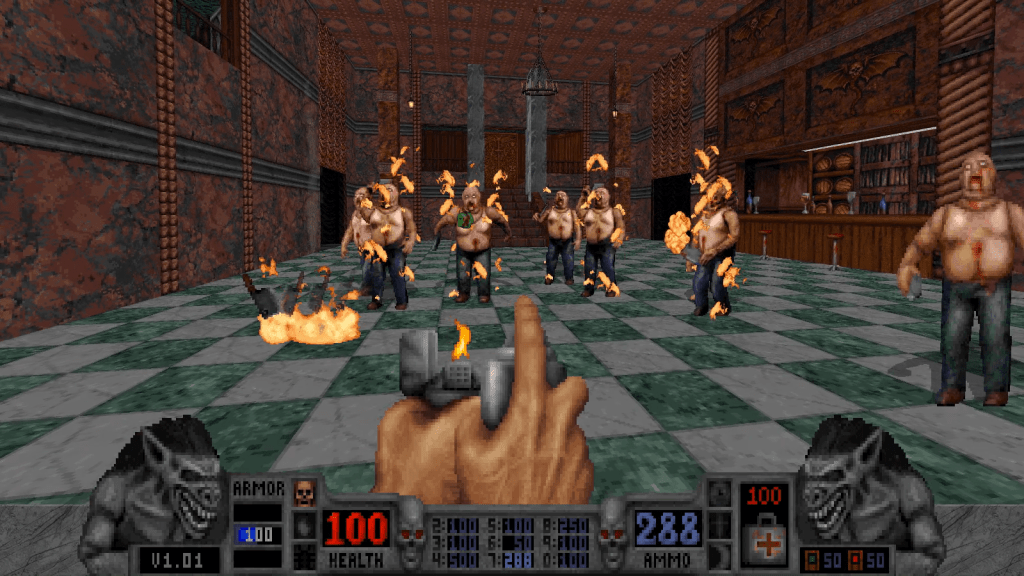
Zombies are easily dispatched with fire and explosives, but you need to make sure you finish the job by burning or blowing them up, lest bullet weapons alone risk having them spring back to life. This makes them low threats who nonetheless take time and focus to kill, and can be shields for your other foes. There are a handful of other little nuisance enemies, rats, spiders that mess up your vision, and choking hands that you need to rip off your throat. These serve to keep you on your toes, as they do a surprising amount of damage and often come in swarms.
A few more are worth noting, the phantasm, a floating grim reaper with a brutal swing who is only vulnerable the instant he goes for an attack, the gillbeast, little fishmen for underwater sections, and the hellhound, an obnoxious wolf that breathes health-shredding fire low to the ground.
That’s an important point as well, Blood uses an old school hitpoint system. It might not seem like it makes much of a difference, but this adds an important element of tension to gameplay.
Without naturally regenerating health, the player finds themselves in situations where they really aren’t prepared for what the game is throwing at them; Blood lets you save and load at any time, but that’s only a small advantage. To get through the toughest of what it has to offer, you need to master the movement and combat, any hit you take is 5%, 10%, 15% less health for the next encounter.
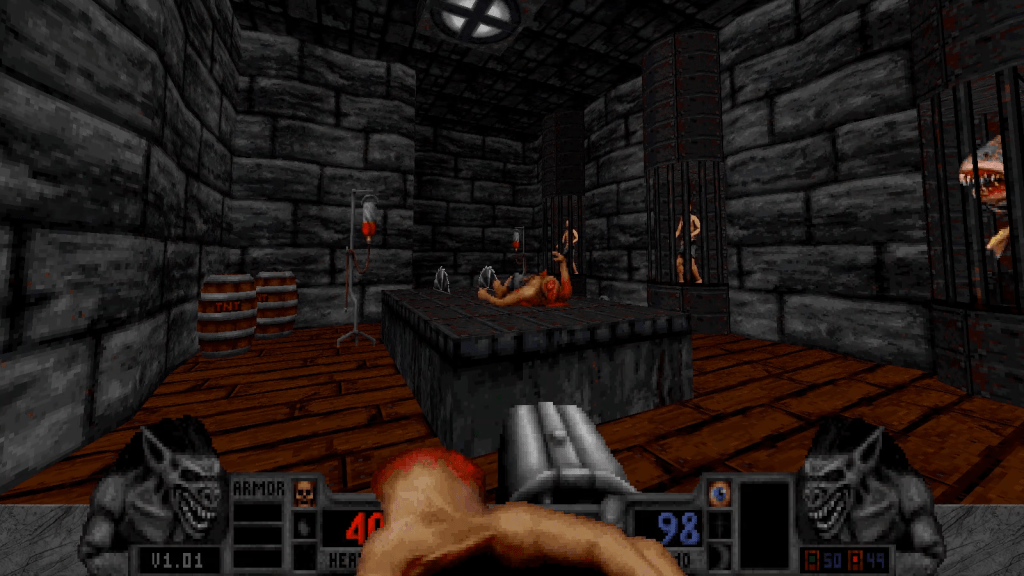
Non-regenerating health is the reason that the game can have a wide variety of enemies, too. Not every monster needs to be able to kill you, some just need to be meat shields or distractions, little things to widdle away at your life. Now, that’s not to say there isn’t anything to help you out. There are health pickups (beating hearts from fallen enemies, of course), and medikits that can be carried around and used to replenish a limited amount of health. There’s also a fairly unique armor system for the time, rather than having a single armor percentage that reduces incoming damage, there are separate meters for standard armor (versus physical attacks), mystic armor (versus magic attacks), and fire armor (versus, well, fire). Splitting it up this way increases the likelihood you’ll find yourself unprepared for a certain enemy, and lets the designers get sadistic, like throwing you a free fire armor before letting a room of hellhounds loose on you.
The medikits are an invaluable item, but Blood has a few more up its sleeve. Jump boots let you leap high up and negate fall damage; they’re fun to use but their energy drains constantly when equipped, so quickly switching them on and off lets you find secrets and make ambushes from high up. The beast vision illuminates enemies, although it never feels necessary to use, unlike the diving suit, which gives you free time underwater without needing to worry about air supply, although it drains very quickly.
Underwater sections in this game are a bit of a pain that I didn’t enjoy very much, however infrequent they are. Caleb can only stay under for so long, and there’s no meter to tell you how much breath he has remaining. Gillbeasts aren’t too bad, though, taken out easily enough via shotgun or tesla cannon, and they’re a joke on land.
What will grate you to no end in the water is, what else? The hitscanners. Everytime a cultist falls below the surface, it’s a nightmare. All of the strategy you normally use against them goes out the window; you just get mercilessly shot up with no sense of where it’s coming from or how many there are, and dynamite and fire are useless. Match that with swimming being much slower than running, and actually getting close enough to land shots from your bullet weapons is a surefire way to become swiss cheese.
Thankfully, a few bad underwater sections can’t damper the rest of the game. The most annoying the water sections got for me in the four episodes of the base game were some early parts of episode two, which sees Caleb venture into the arctic.
Every episode takes a similar structure, beginning with a very well-realized setting before transitioning into the Cabal’s temples, caves, and catacombs. Episode one has a very rural, countryside feeling, culminating with Caleb’s battle against Cheogh, a stone gargoyle who’s killed and crucified his girlfriend, Ophelia. Stephan Weyte’s tremulous delivery of “Show yourself… Show yourself!” upon seeing her corpse still makes me tremble.
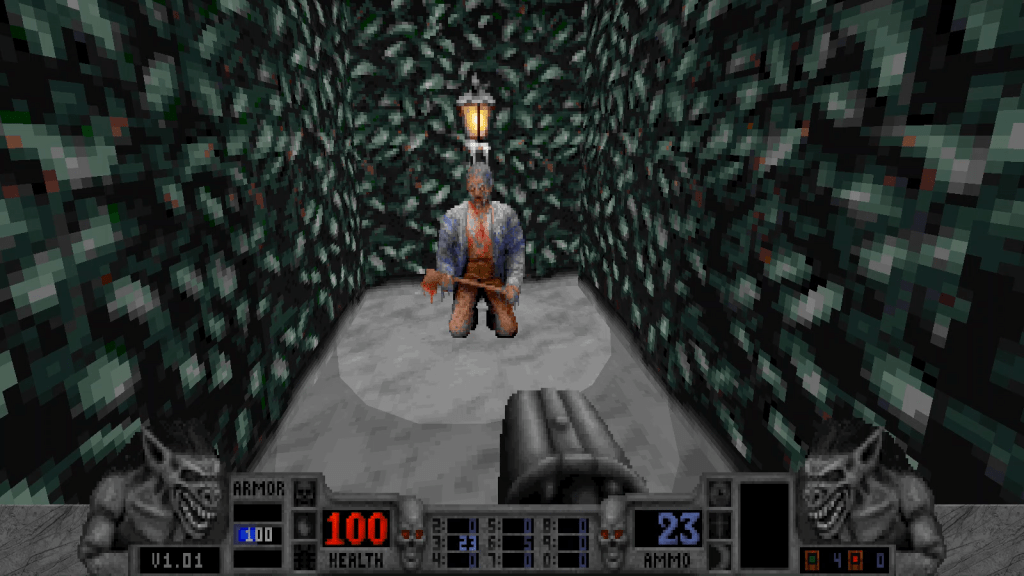
Episode two’s isolated, snowy levels are some of my favorites in the whole game. The Build Engine excels at taking recognizable locations and making them just abstract enough to be arenas for over-the-top action. “Even Death May Die,” as the episode is called, starts you off boarding a ship locked by ice, a common fate for arctic explorers, before fighting off the presumable zombies of the crew. A journey through a labyrinthine hedge maze brings you to a location based off of the Overlook Hotel from The Shining in a level subtly titled “The Overlooked Hotel.” The architecture and layout is perfect, just close enough to a real building to give the sense of walking through its decrepit, carpeted halls, only to throw open a wall and find a network of secret passages around the level, one of which contains a row of bloodthirsty zombies and butchers for you to burn down with your aerosol can. It’s even complete with a scavenger hunt to find a series of hidden tomes that open a portal to a secret level.

Episode three is one of my favorites for the choice of locations alone. Set in a dark urban backdrop, Caleb finds himself in a French town overtaken by Tchernobog’s forces. After setting off explosives to bring down a whole building, Caleb progresses to one of my favorite levels, E3M2: The Siege. Caleb awakes after sleeping the night in an abandoned tenement, only to look out the window and see the military carpet bombing the streets, what few civilians remain, driven insane by the twisted forces of The Cabal, run around frantically while a siren blairs. You dash out of the apartment, fighting through a bank, meat processing plant, and a city hall overrun with the undead and unhinged. The atmosphere and pacing at this point in the game is incredible, and while many have criticised the sewer level that follows (I will not defend it either), another favorite appears soon after, E3M4: Sick Ward. A whole level in a hospital, wonderfully realized and filled with surprises, from morgue lockers bursting open with crawling hands to zombies that jump up from surgery tables.
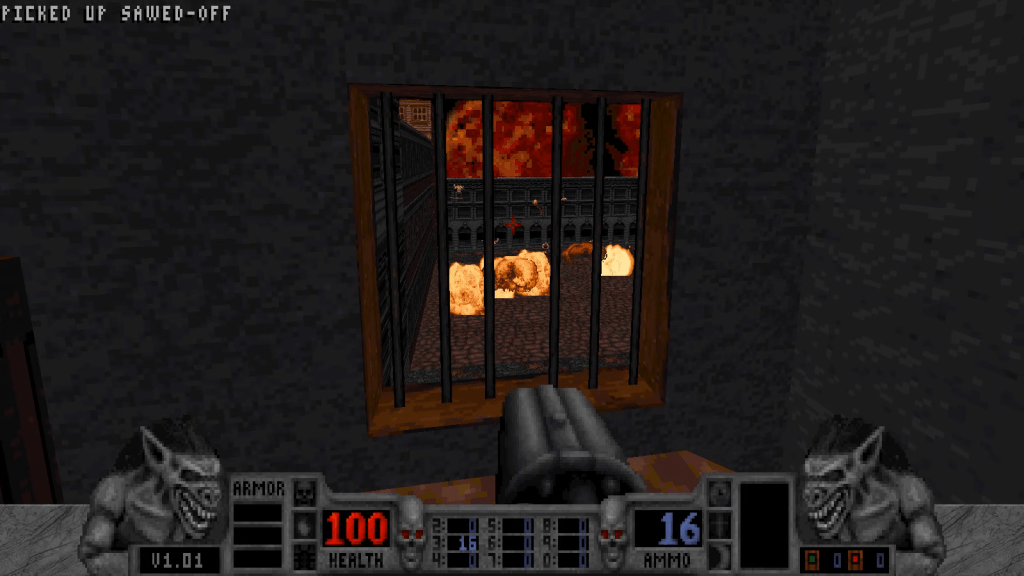

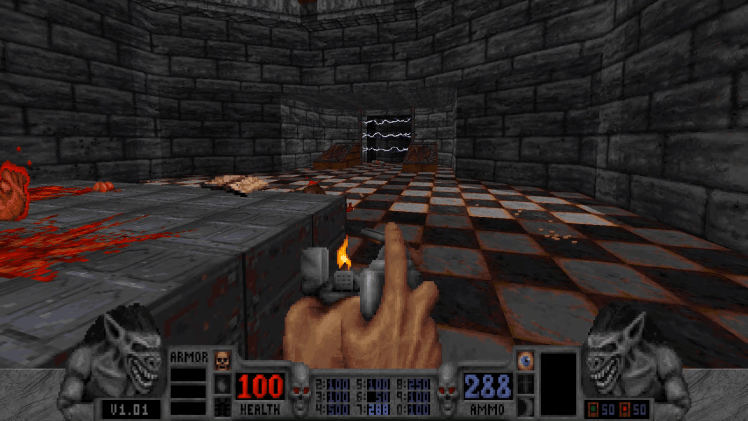
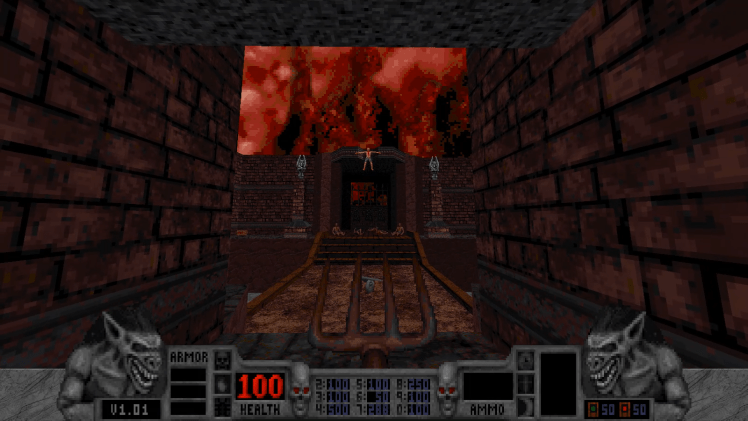
Episode four is where the game begins to slip for me. Levels are sometimes jarringly brief and don’t flow together with the same logical consistency as previous episodes before delving right into the same temples and castles. There are some good ideas, though, like a mad scientist’s lab and a spooky swamp, but they just sort of… start and end with little story. It does contain a great secret level in Mall of the Damned, which is forgivable for being non-sequitur by nature. The penultimate level, In the Flesh, is awesome, however, and I think more of the episode should have built up to it. A level inside a Silent Hill-like hellscape of fleshy walls and floors that bleed when you hit them. Parts of the environment move and shift in a rhythmic way like the inner workings of some huge animal, and there’s a gross but fascinating element of body horror to the whole thing. The previous level ends, however, with you just… finding this place. No explanation, and as soon as it’s over, you step right back out into Tchernobog’s temple for the final confrontation.

“What? What was that? All that fleshy stuff? Are we going to address that?”
Unfortunately, nope.
You might have noticed that despite speaking at length about the combat in Blood, I’ve neglected to mention the boss battles. That isn’t because they’re great.
Bosses in FPS games are tricky. The reason that the enemy encounters in the rest of the game work so well is because of that chess piece theory of mixing and matching the qualities of each monster. When you try to condense all of that into a single foe, you unfortunately will often end up with a big bad who is, ironically, easier than the rest of their minions. With the exact same arsenal, the penultimate level of an episode can be tough as nails, but the boss in the very next level is easy enough to be a letdown, a “Shoot it ‘til it dies” fight.
I get the feeling that the developers at Monolith knew this, and tried to compensate for the lackluster boss design by throwing in some extra things to worry about for each encounter. Cheogh, the stone gargoyle of episode one, is accompanied by two regular gargoyles at his side. He’s pretty easily cheesed out by crouching, where his magic eye beams can’t hit you. Shial, the giant spider mother of episode two spawns tons of little spiders to preoccupy you, but a large supply of napalm exterminates her offspring and bounces her around the arena like a balloon until she finally gives out. Cerberus, who is exactly what he sounds like, launches two napalm shots at you at once. This is only made difficult by the fact that taking one hit will blind you with a red screen from the sheer damage you take, and makes getting hit a second time more likely.
It was a common trope among shooters at the time for the boss of one episode to reappear in later episodes as a regular enemy, and while I understand this choice to flesh out the enemy roster and have an easy choice for a miniboss, it kind of diminishes their prestige.
The final boss, Tchernobog, The Devourer of Souls, The One that Binds, the culmination of this whole bloody quest for vengeance, can be defeated in less than ten seconds.
I’m serious. The last level, Hall of the Epiphany, is a boss rush of Cheogh, Shial, and Cerberus in succession, but you’re given more than enough ammo for each of your weapons to deal with them, and they’re more of a time-waster than anything else. Step into Tchernobog’s throne room only to find his seat empty. “Hm?” Everything is quiet.
Suddenly, after touching a pillar, the room is filled with thunderous lights and evil energy, and a wall opens as the ancient god cries,
“I HAVE AWAITED YOU. KNEEL BEFORE ME.”
And Caleb replies, in his gravelly gunslinger tone,
“I’m gonna have to put you down.”
Oh hell yeah, this is awesome! Tchernobog is revealed behind the wall, a towering skeleton with a goatlike skull, what little remains of its flesh drenched in dried blood, his claws drawn near his chest and holding a pale blue orb of flame. This is it, the final showdown.
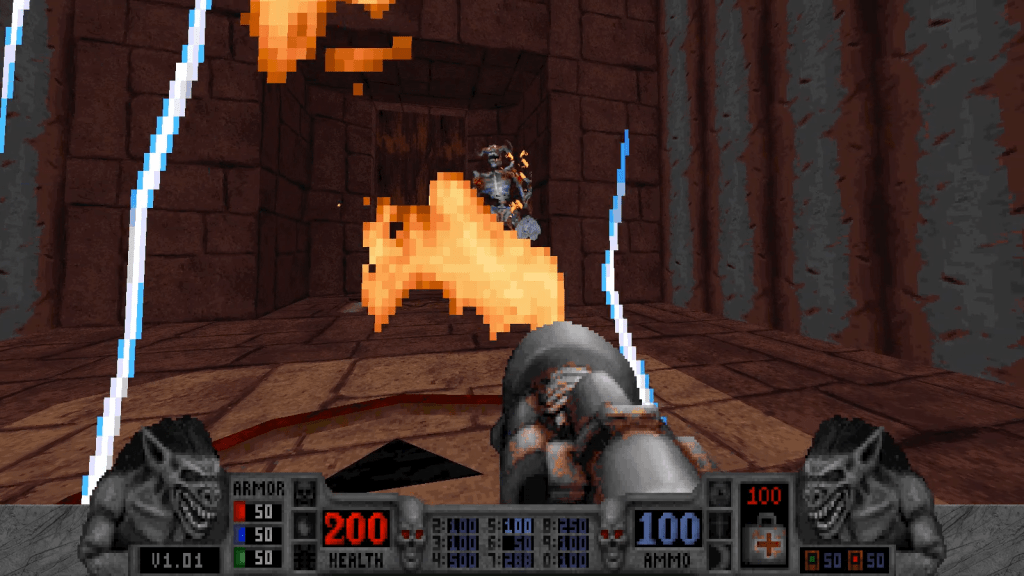
Then you pump napalm and tesla cannon into him, so much that he can’t even leave his little room behind the wall, and he falls over before disintegrating.
Oh, okay.
Don’t get me wrong, just because Blood’s ending is a little weak doesn’t mean by any stretch of the imagination that you should skip out on it. It’s a quintessential title in classic 90s-era shooters, a style that has recently begun to be revived with beautiful titles like Dusk, Amid Evil, Strafe, and id Software’s newest reimaginings of Doom. The combat is fierce, the atmosphere dense, the art style gorgeous in its dreariness. I haven’t mentioned the soundtrack, but it chose to stray from the badass metal of Doom and rock of Duke 3D for a more ambient, creepy mood. Composer Guy Whitmore, assisted by Daniel Bernstein, specialized in making adaptive soundtracks for games, where music fades in and out on cue, and while I can imagine what a Lee Jackson or even Michiru Yamane score would have sounded like, Blood is unique for that kind of ambience.
If you played Doom Eternal and are curious about the roots of its blistering combat, certainly check out the original installments. If you feel up to the challenge, however, the lovely people at Nightdive Studios put out a remaster of this game with code written from the ground up. Blood: Fresh Supply includes both expansion episodes, Cryptic Passage and Post Mortem, as well as reworked netcode and a host of configuration options.
Seriously, play Blood.
I mean it, play Blood.
 Taigen Moon Works